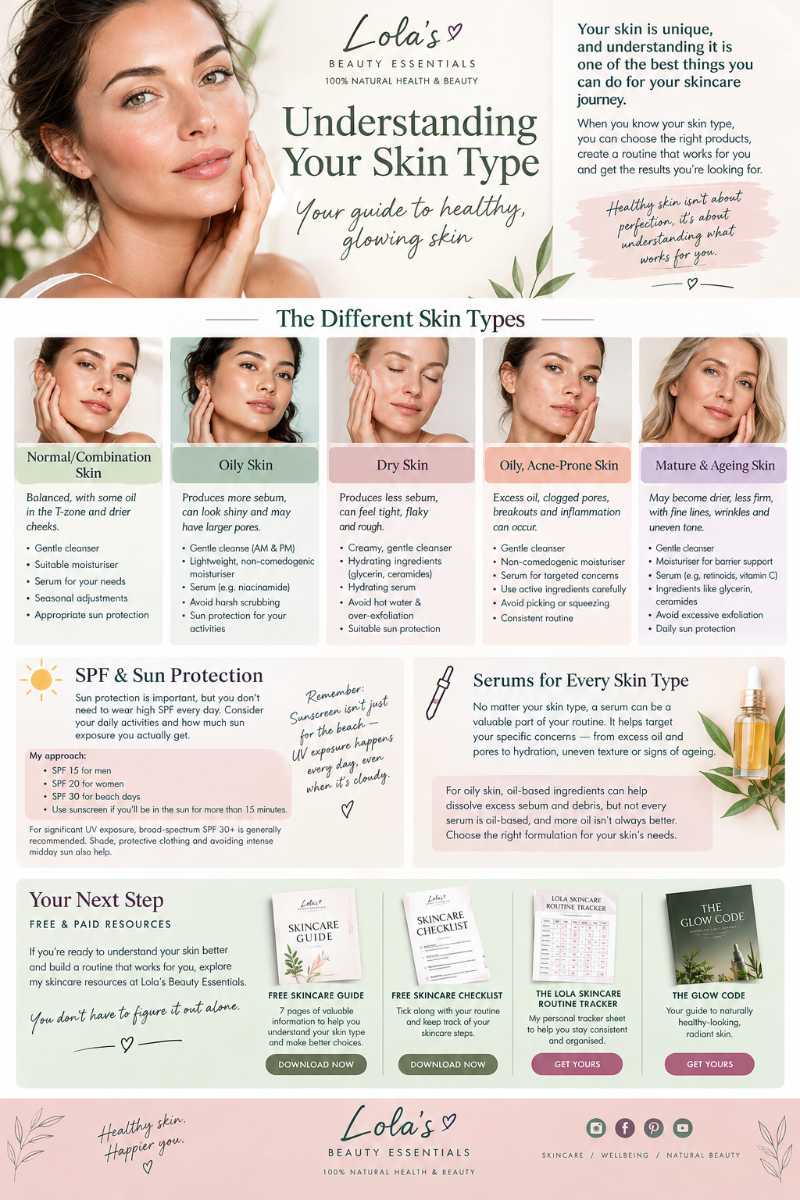
Understanding Your Skin Type: Your Guide to Healthy, Glowing Skin
Introduction
When it comes to skincare, one of the most important things you need to understand is your skin type.
We all want healthy, beautiful, glowing skin, but what works for one person might not work for another. You can buy the most expensive skincare products, follow somebody else's routine and use all the trending ingredients, but if those products aren't suited to your skin, you might not get the results you're looking for.
This is why understanding your skin should always be the starting point.
Your skin has its own needs, and once you understand those needs, choosing the right products and building a skincare routine becomes so much easier.
Today, we're looking at the different skin types, how to recognise them, and what you can do to care for your skin.
Let's get into it!
1. Normal/Combination Skin
Let's start with normal/combination skin.
Normal skin is generally well-balanced. It isn't excessively oily or particularly dry, and the skin usually feels comfortable throughout the day. You may have relatively small pores, an even texture and few areas of excess shine or flakiness.
Of course, normal skin can still experience breakouts, sensitivity or dehydration. Having normal skin doesn't mean your skin will never have problems.
Combination skin, on the other hand, has a mixture of oily and normal or dry areas. You'll often notice more oil around your forehead, nose and chin, which we call the T-zone, while your cheeks may feel normal or dry.
You might find that your makeup becomes shiny around your nose but looks perfectly fine on your cheeks. Or perhaps your forehead gets oily during the day while the rest of your face feels comfortable.
These are common signs of combination skin.
How do you care for normal/combination skin?
The goal is to maintain balance without overloading your skin with too many products.
- Use a gentle cleanser that doesn't leave your skin feeling tight.
- Choose a moisturiser suited to your skin's needs.
- Incorporate a suitable serum into your routine to address your particular skin concerns.
- Pay attention to changes in your skin throughout the seasons.
- Choose sun protection according to your skin and expected UV exposure.
You don't necessarily need a separate product for every area of your face. Start with a balanced routine and make adjustments where necessary.
2. Oily Skin
Now, let's talk about oily skin.
Oily skin produces more sebum, which is the natural oil made by your sebaceous glands. Sebum helps protect and lubricate your skin, so oil itself isn't the enemy. The challenge comes when your skin produces more oil than you'd like.
If your face tends to look shiny a few hours after cleansing, your pores are more noticeable, or you regularly find yourself reaching for blotting paper, you may have oily skin.
You might also notice that makeup slips, separates or becomes shiny more quickly throughout the day.
One important thing to understand is that oily skin can still be dehydrated. Oil and water are not the same thing. Your skin can produce plenty of oil while still lacking water, which is why stripping your skin with harsh cleansers can make things worse.
How does oil work with oil?
This is something worth understanding when choosing skincare products.
Oil-based ingredients can help dissolve oily residue, makeup and excess sebum. This is one reason oil cleansing can be useful for certain people with oily skin.
However, not every oil suits every skin type, and using more oil doesn't automatically mean you'll have better skin. The formulation, ingredients and how your skin responds all matter.
The idea is to choose products that work with your skin rather than trying to strip away every trace of its natural oil.
How do you care for oily skin?
- Cleanse gently, generally morning and evening.
- Choose lightweight, non-comedogenic moisturisers where appropriate.
- Incorporate a serum suited to your skin's needs.
- Consider ingredients such as niacinamide if your skin tolerates them.
- Avoid scrubbing your face aggressively or washing it repeatedly to remove shine.
- Choose suitable sun protection for your activities and exposure.
I would always encourage you to consider a serum as part of your skincare routine. A serum can help target specific concerns, whether that's excess shine, dehydration, uneven texture or the appearance of pores.
And please, don't skip moisturiser just because your skin is oily!
Your skin still needs hydration and moisture. You simply need to find products with textures that work for you.
3. Dry Skin
Dry skin is different from oily skin because it generally produces less sebum.
If your face often feels tight after cleansing, looks flaky, feels rough or becomes uncomfortable during colder weather, you may have dry skin.
You might also notice that foundation clings to dry patches or that your skin looks dull even when you're taking care of it.
Dry skin can be influenced by genetics, weather, age, certain skincare products and changes in the skin barrier.
It's also important to distinguish between dry skin and dehydrated skin. Dry skin is generally associated with a lack of oil, whereas dehydrated skin lacks water. You can have oily but dehydrated skin, too.
How do you care for dry skin?
Your focus should be on supporting the skin barrier and helping your skin retain moisture.
- Choose a gentle, creamy cleanser rather than one that leaves your face feeling stripped.
- Look for moisturising ingredients such as glycerin and ceramides.
- Consider a hydrating serum to support your routine.
- Apply moisturiser while your skin is slightly damp to help retain hydration.
- Avoid excessively hot water and over-exfoliating.
- Pay attention to sun exposure and choose appropriate sun protection.
Ingredients such as glycerin help attract water to the skin, while ceramides help support the skin barrier.
You can also look at suitable facial oils if your skin needs additional emollient support, but remember that not every oil is suitable for everyone.
And here's something important: natural doesn't automatically mean suitable for every skin type. Even natural oils and botanical ingredients can irritate some people or trigger sensitivity.
The important thing is finding products that your skin tolerates and that help it feel comfortable.
4. Oily, Acne-Prone Skin
This is an important one because oily skin and acne-prone skin are related, but they aren't exactly the same thing.
You can have oily skin without experiencing acne, and you can experience acne without having particularly oily skin.
Acne-prone skin may develop blackheads, whiteheads, inflamed pimples and, in some cases, deeper and more painful breakouts. Oil production, clogged pores, inflammation, hormones and other factors can all contribute.
You may notice that your skin breaks out more frequently around certain times of the month. Hormonal fluctuations can play a role in acne for some people, although breakouts can have several different causes.
How do you care for oily, acne-prone skin?
When you're experiencing breakouts, it can be tempting to cleanse more often, exfoliate every day or use several strong ingredients at once.
But irritating your skin can make things more uncomfortable.
Instead:
- Use a gentle cleanser and avoid aggressive scrubbing.
- Choose non-comedogenic moisturisers where possible.
- Consider a suitable serum that targets your particular skin concerns.
- Introduce active ingredients carefully and according to product directions.
- Avoid picking or squeezing pimples, as this can increase inflammation and the risk of scarring.
- Introduce new products gradually so you can identify what works for you.
Ingredients such as salicylic acid may help with clogged pores, while benzoyl peroxide can help treat acne. Your choice of products should depend on your skin's needs and how well it tolerates them.
If your acne is painful, persistent or causing scars, it's worth consulting a dermatologist or another appropriately qualified healthcare professional.
You don't need a ten-step routine to care for acne-prone skin. Consistency is much more useful than constantly changing products.
5. Mature and Ageing Skin
Now, let's talk about mature skin.
As we get older, our skin naturally changes. It may become drier, feel less firm, develop fine lines and wrinkles, and show more uneven pigmentation or sun damage.
The rate and extent of these changes vary from person to person. Genetics, sun exposure, lifestyle and hormonal changes can all influence how our skin looks and feels.
Mature skin isn't a separate oil category in the same way as dry or oily skin. You can have mature skin that is oily, dry, combination or sensitive.
This is why it's important to look at your skin as a whole rather than relying on age alone to determine what products you need.
How do you care for mature skin?
My approach is to focus on keeping the skin healthy, hydrated and protected.
- Use a gentle cleanser that doesn't strip away your skin's natural oils.
- Choose a moisturiser that supports the skin barrier and helps reduce moisture loss.
- Consider a suitable serum to address your skin's individual concerns.
- Look at ingredients such as glycerin, ceramides or vitamin C, depending on your needs.
- Avoid excessive exfoliation, particularly if your skin is becoming more sensitive or dry.
- Be mindful of UV exposure and choose suitable sun protection.
Serums can be particularly useful here because they allow you to target specific concerns, such as dehydration, uneven texture or the appearance of fine lines.
However, no skincare product can stop the natural ageing process completely, and results vary.
You also don't have to spend a fortune to look after mature skin. A consistent routine built around cleansing, moisturising and suitable targeted products is an excellent place to start.
The goal isn't to look like somebody else or erase every line on your face. It's to keep your skin looking and feeling its best.
A Note on SPF and Sun Protection
Sun protection is an important part of skincare, but I believe it's also important to consider your daily activities and how much sun exposure you actually receive.
Not everyone spends hours outdoors every day, and your routine should take your circumstances into account.
My general approach is to consider SPF 15 for men, SPF 20 for women and SPF 30 for beach days, while paying attention to how long you'll be exposed to the sun. If you expect to spend more than 15 minutes in the sun, sun protection becomes a more important consideration.
It's also worth remembering that sunscreen products and their ingredients differ. If you have concerns about a particular product, look at its ingredients and choose a product appropriate for your skin and circumstances.
For significant UV exposure, broad-spectrum SPF 30 or higher is generally recommended by public-health guidance. Shade, protective clothing and avoiding intense midday sun can also help reduce exposure.
Ultimately, understand your skin, consider your environment and make informed decisions about the products you use.
So, Which Skin Type Do You Have?
Now that we've covered the different skin types, you might be thinking, "Lola, I recognise myself in more than one of these!"
And that's completely understandable.
You might have normal/combination skin that becomes dehydrated, oily skin that is acne-prone, or mature skin that is also dry and sensitive.
Your skin can change with the seasons, hormonal fluctuations, age and the products you use.
This is why I always encourage you to get to know your skin before investing in skincare products.
Pay attention to how your skin feels after cleansing, where you experience shine, whether you notice dry patches and how your skin responds to the products you're currently using.
You don't need to buy everything at once. Start by understanding your skin, then build a routine around its needs.
And remember: more products don't automatically mean better skin.
A simple, consistent routine with suitable products can be far more useful than following every new skincare trend.
Your Next Step Towards Healthy, Glowing Skin
If you're ready to understand your skin better and start building a routine that works for you, I've created a few resources to help you along the way.
Start with my free Skincare Guide
My free, seven-page Skincare Guide is designed to help you understand your skin type and make more informed skincare choices.
It's a great starting point if you're not quite sure where to begin or which areas of your skincare routine need attention.
Download my free Skincare Checklist
I've also created a free Skincare Checklist that you can use to tick along with your routine and keep track of the steps you're taking to care for your skin.
Sometimes, having everything in front of you makes it easier to stay organised and consistent.
The Lola Skincare Routine Tracker
Once you're ready to take things further, you can explore my paid skincare resources.
The Lola Skincare Routine Tracker is my own skincare tracker sheet, inspired by the routine I use to keep my skin on track. It helps you organise your routine and stay consistent with your skincare habits.
Discover The Glow Code
And then there's The Glow Code — my skincare guide for anyone who wants to work towards naturally healthy-looking, radiant skin and build a better understanding of their skincare routine.
Whether you're just starting your skincare journey or looking to improve what you're already doing, there's a resource to help you take that next step.
You don't have to figure everything out on your own. Start with the basics, learn what your skin needs, and build from there.
Explore the skincare resources available through Lola's Beauty Essentials and take the first step towards your own healthy-skin journey.
Conclusion
Your skin is unique, and understanding it is one of the best things you can do for your skincare journey.
Whether your skin is normal/combination, oily, dry, acne-prone or showing signs of ageing, the foundation remains the same: understand your skin, choose suitable products, support your skin barrier and stay consistent.
You don't need to chase perfection. You need to understand what works for you.
Thank you for joining me for this week's skincare conversation. I hope you've learnt something useful and feel a little more confident about understanding your own skin.
If you haven't already, start with my free Skincare Guide and Skincare Checklist, then explore The Lola Skincare Routine Tracker and The Glow Code when you're ready to take the next step.
Until next time, keep looking after yourself and your skin.
Lola's Beauty Essentials — 100% natural health & beauty.